
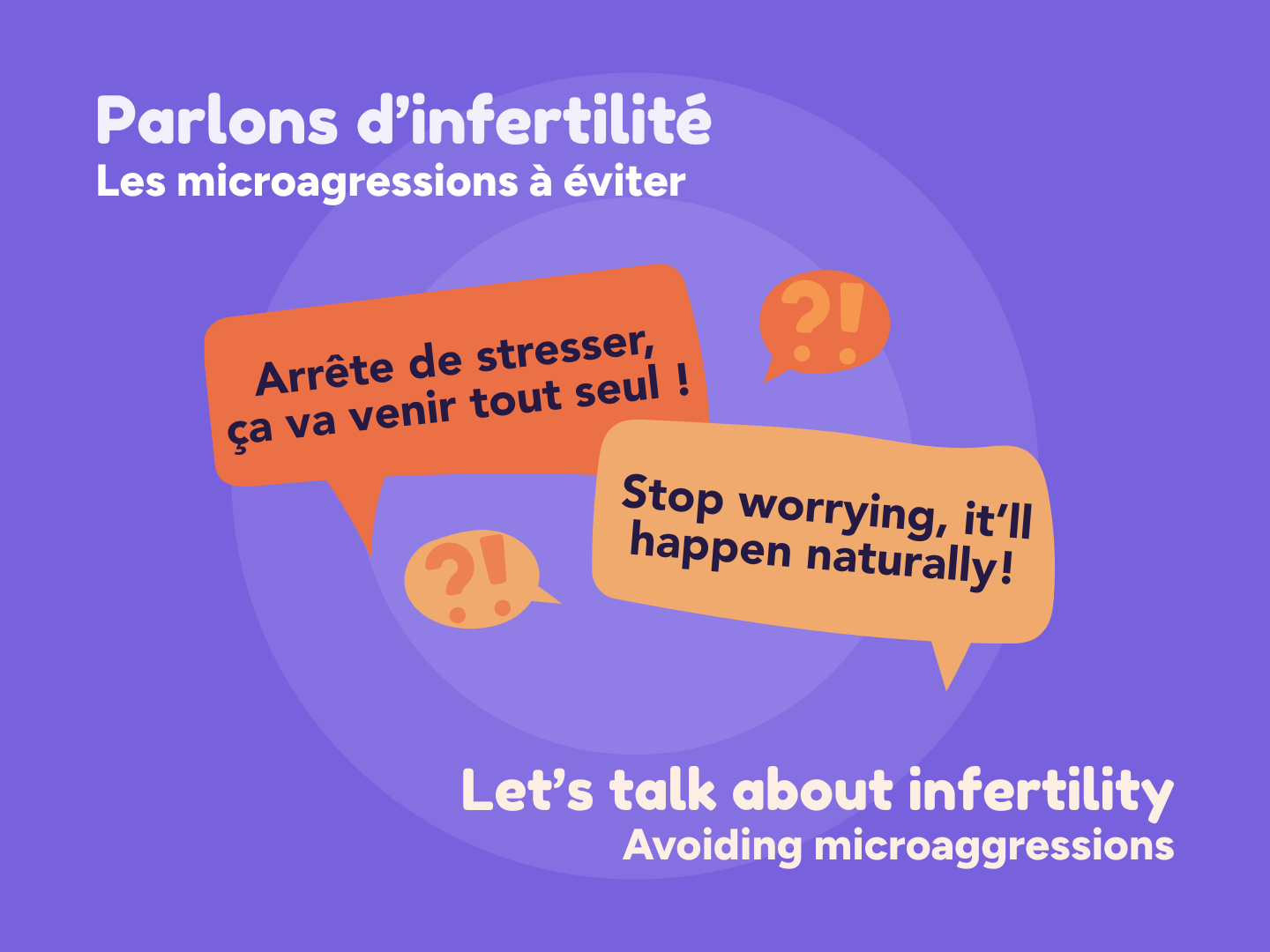
We are proud to present our brand new toolkit series, Let’s Talk About Infertility! Created by the Canada Research Chair in Third-Party Reproduction and Family Ties and the Centre ESPER, this series focuses on avoiding microaggressions towards people who suffer from infertility.
Each toolkit analyzes a microaggression, explains why the comment may be hurtful to someone experiencing infertility, and suggests alternative phrases to use.
We would like to thank everyone who made this series possible: Anne-Julie Belleau, Anne-Marie Luca, Isabel Côté, Loïs Crémier, Marie-Christine Williams-Plouffe, as well as the Centre ESPER professionals who submitted suggestions for microaggressions to address.
What is a microaggression?

The term “microaggression” was coined by American psychiatrist Chester M. Pierce to refer to racist insults and derogatory remarks made by white people to Black people in their everyday lives.
Today, the term is used more broadly to refer to everyday remarks that can invalidate a person’s feelings or communicate bias or prejudice toward the group to which they belong (e.g., racialized people, women, people suffering from infertility, etc.).
People who commit microaggressions may do so unintentionally – without realizing the derogatory or insensitive nature of their comments.
To view our toolkits, visit the Chair and the Centre ESPER’s social media pages, or download them as printable pamphlets.
Guide: What to say and not to say to a loved one who is experiencing infertility?
Guide (in French): Quoi dire et ne pas dire à un proche qui vit de l’infertilité ?
Pamphlet #1: So, when are you going to have kids?
Pamphlet #6: Is it you or your partner?
Pamphlet #1 (in French): Alors, c’est pour quand les enfants ?
Pamphlet #6 (in French): Ça vient de toi ou de ton·ta partenaire ?
Pamphlet #2: Are you sure you want children?
Pamphlet #7: I know *someone* who had trouble getting pregnant – and then she had her miracle baby
Pamphlet #2 (in French): T’es sûr·e que tu veux des enfants ?
Pamphlet #7 (in French): Je connais *une telle* qui avait de la difficulté à tomber enceinte et qui a eu son bébé miracle
Pamphlet #3: Well, you should be happy for others when they get pregnant!
Pamphlet #8: Stay positive!
Pamphlet #3 (in French): Ben là, sois content·e pour la grossesse des autres ?
Pamphlet #8 (in French): Reste positif·ve !
Pamphlet #4: Stop worrying, it’ll happen naturally!
Pamphlet #9: Maybe you aren’t meant to have kids
Pamphlet #4 (in French): Arrête de stresser, ça va venir tout seul !
Pamphlet #9 (in French): Vous n’êtes peut-être pas du·es pour avoir des enfants
Pamphlet #5: Have you ever considered adopting a child?
Pamphlet #10: Well, you could adopt a dog!
Pamphlet #5 (in French): Vous avez déjà pensé à adopter ?
Pamphlet #10 (in French): Vous pourriez adopter un chien ?
Follow the Chair’s activities
Follow the Centre ESPER’s activities
Sources for the section on microaggressions:
Ryu, H., & Pratt, W. (2022). Microaggression clues from social media: revealing and counteracting the suppression of women’s health care. Journal of the American medical informatics association, 29(2), 257-270.
Sue, D. W. (2010). Microaggressions in Everyday Life: Race, Gender, and Sexual Orientation. John Wiley & Sons.