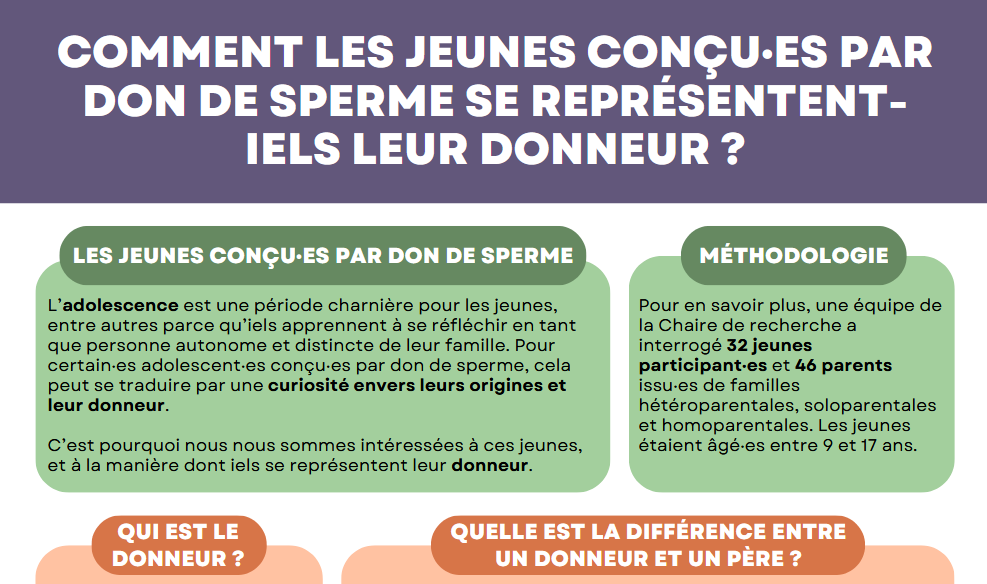
The future of children born via sperm donation, their viewpoint on the particular circumstances of their conception, the identity dynamics that ensue, and their relationship to their parents are at the heart of current academic concerns. However, we know very little about how these young people make sense of the circumstances related to their birth, because most studies on the topic interview adults who analyze their reactions retrospectively, in adolescence, or parents who report on their perception of their child’s reaction to disclosure. This project aimed to better understand the way teenagers conceived via sperm donation integrate the narrative of their conception and their subjective sense of identity. To achieve this, we analyzed the narratives of a group of young people growing up in families with heterosexual, lesbian and single parents, and we compared their narratives with their parents’ point of view. This triangulation helped add nuance and increase the validity of research results, which brings out a broad and original understanding of these families.
The research results provide a better understanding of the issues that arise when people start a family with the help of sperm donation, both for adolescents and for their parents. This study also identifies promising avenues for professional practice updates in fertility clinics’ assessment of couples seeking gamete donation.
This project was led by principal investigator Isabel Côté (UQO), with co-researchers Sabrina Zeghiche (UQO), Raphaële Noël (UQAM), Kévin Lavoie (U Laval), Katherine Péloquin (U de Montréal), Christine Gervais (UQO) and Diane Dubeau (UQO).