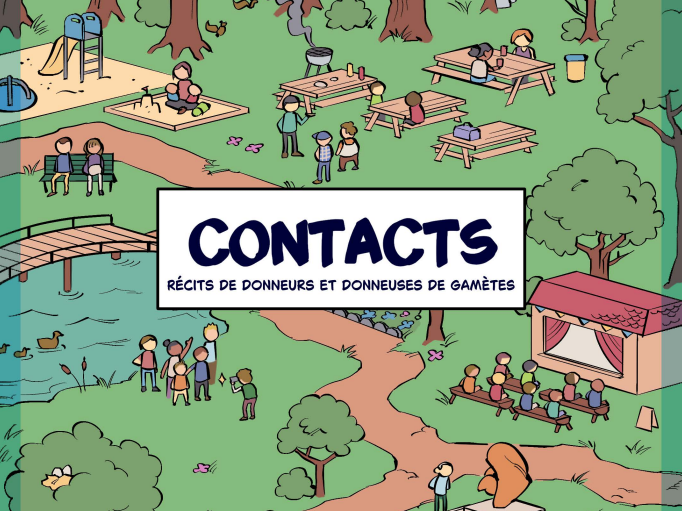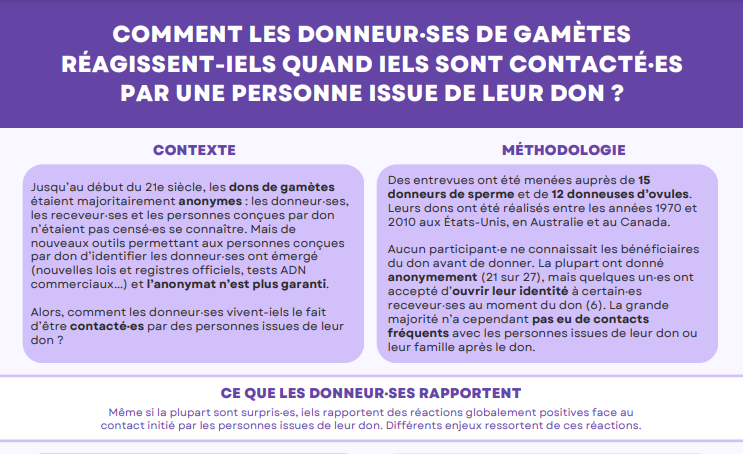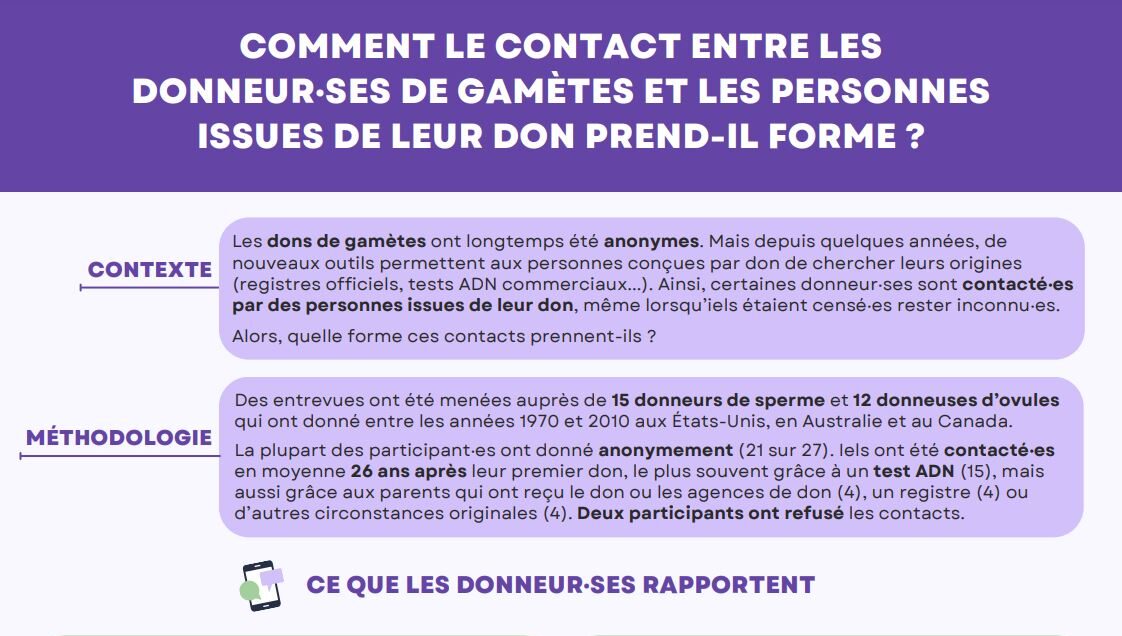

While the anonymity of sperm and egg donors was the organizing principle of assisted reproduction in many countries until the early 2000s, more and more people have spoken out in Canada and elsewhere to demand that donor-conceived people have better access to their origins. Concurrently, an entire market has developed around DNA testing to identify one’s so-called “ethnic” origins and find genetic relatives. Such tests have led many people to unexpectedly discover that they were born thanks to gamete donation. Some people have also used these commercial databases to get around the anonymity rules that were in effect in their countries and identify their donor. What happens when people find the donor who made their birth possible? There is still very little empirical research on the subject.
The Contact project examined situations in which a gamete donor is directly contacted by a donor offspring that they did not previously know about. The study helped better understand the consequences of the expansion of donor conceived people’s access to information about their origins. It provides pathways for people working in the field of assisted reproduction with regard to supporting users and can be mobilized by lawmakers interested in the issue.
This project was led by principal researcher Anaïs Martin (UQO) with co-researcher Isabel Côté (UQO).
This project was made possible thanks to the financial support of the Social Sciences and Humanities Research Council of Canada (SSHRC) [Canada Research Chair in Third-Party Reproduction and Family Ties, 2020–2025].